Getting It Right

I’ve posted steadily about our trip to southern Africa. It’s fun to write about! The region is a bottomless wellspring of inspiration.

That trip gave me something I don’t feel very often: hope.

We’ve spent months in Asia in natural habitats that are now being dammed, or mined, or paved in the name of progress. It’s all happening so quickly. We know we won’t recognize those places when we go back.

Laos. China is damming the Mekong River and neighbors to the south will be impacted (ie, all of them)
Borneo. Indonesia has moved the capitol city Jakarta from Java to Borneo, reducing the orangutan’s habitat even further
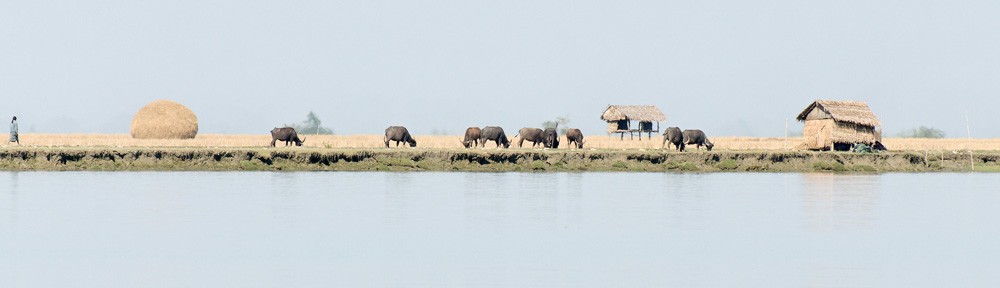
Sittwe, Burma. The junta is crushing all resistance; Uwe and I won’t be allowed to visit this region if we go back
northern Cambodia/Laos border. The rare Irrawaddy dolphin will go extinct if the water in the Mekong River is further reduced

But in southern Africa, in Botswana and Namibia, we were thrilled by the wildlife and the inhabitants. These countries spoke in growls and whistles and birdsong and hippo songs and human voices.

The Kavango-Zambezi Transfrontier Conservation Area (KAZA TFCA) is the largest transnational conservation area in the world at 444.000 km2. It is  enormous, larger than Germany and Austria combined and nearly twice as large as the United Kingdom. The KAZA TFCA lies in the Kavango and Zambezi river basins where Angola, Botswana, Namibia, Zambia and Zimbabwe converge. [1]

There are issues to deal with – the loss of domestic animals to predators. The way elephants eat or trample crops. The complicated cross-country agreements.  But, as their website states, “Local communities participate with enthusiasm in management of the TFCA through the Transboundary Natural Resources Managment Forum. The aim of this forum is to maximize skills and resources to promote sustainable land use, conservation of wildlife and landscapes, and rural development.”

I urge everyone to learn about this multinational effort to preserve the environment for the benefit of ALL inhabitants, whether winged, hooved, legged, or finned. FINALLY! A region of the world that’s getting it right!

NOTES: [1] https://www.kavangozambezi.org/  ©2024 Jadi Campbell. Photos ©2023 Uwe Hartmann. Uwe’s photos of our trips and his photography may be viewed at viewpics.de.

Victoria Falls, Zimbabwe

My books are Broken In: A Novel in Stories, Tsunami Cowboys,  Grounded and The Trail Back Out.

Tsunami Cowboys was longlisted for the 2019 ScreenCraft Cinematic Book Award. Broken In: A Novel in Stories was semifinalist for the international 2020 Hawk Mountain Short Story Collection Award from Hidden River Arts and Finalist for Greece’s 2021 Eyelands Book of the Year Award (Short Stories).

The Trail Back Out was the 2023 San Francisco Book Festival Winner for General Fiction, American Book Fest 2020 Best Book Award Finalist: Fiction Anthologies, Runner-Up for the 2021 Top Shelf Award, 2021 IAN Book of the Year Award Short Story Collection Finalist, and awarded a 2021 Wishing Shelf Red Ribbon. The title story The Trail Back Out was longlisted for the 2021 ScreenCraft Cinematic Short Story Award.

Click here for my author page to learn more about me and purchase my books.

Today’s Birthday: Valerie Jane Morris-Goodall

Dr. Jane Goodall was born on April 3, 1934 in Hamstead, London, England. She is a anthropologist and primatologist, acknowledged as the world’s expert on chimpanzees. In 1960 she went to the Gombe Stream National Park of Tanzania to study the Kasakela chimpanzee community. That study is still going, making it the the longest continuous study of animals in their natural habitat [1]. In her honor I give you the post I wrote after we visited the orangutan rehabilitation center on Borneo. – Jadi

In 2019 we saw our first free roaming orangutan.

We were at Semenggoh Nature Reserve, just south of Kuching in the Sarawak state on Borneo. Semenggoh is also a Wildlife Centre, established in 1975 as a rehabilitation sanctuary. They take in injured, orphaned, or rescued orangutans. The sole goal of the centre is the rehabilitation and gradual return of animals to fend for themselves in the wild.

Orangutans are endangered, rare, marvelous. They’re native to only two places on the entire planet: Borneo or Sumatra. Our chances of running across them in the wild were pretty much zero, but at Semenggoh maybe we could watch them feeding.

Our individually booked, guided visit conjoined with the larger international tourist groups. The centre gives educational lectures. We learned the rarity and habits of these giant primates. Orangutans spend at least 60% of their waking time looking for food. “Their diet consists of 300 different kinds of fruit such as barks, honey, young shoots, insects and occasional bird egg and small vertebrae. Fruits make up 60% of the orangutan’s diet.” Also (this fact surprised me), “a 1-mile square radius of rainforest can only support a low population density of about 2.5 orangutans.”  [2]

The centre maintains a feeding platform. Orangutans are called back for lunch if they want it. But the jungle vegetation fruited a second time last winter, and we were informed that if the orangutans didn’t show, this was a sign that they were fending successfully for themselves in the thick woods. And indeed, none of the creatures responded to the rangers’ calls. [3]

We waited patiently for the tardy luncheon guests. Then suddenly walkie talkies crackled. The seemingly relaxed park guides sprang into action, urging everyone back towards the entrance. A ranger had spotted an orangutan!

Seduku

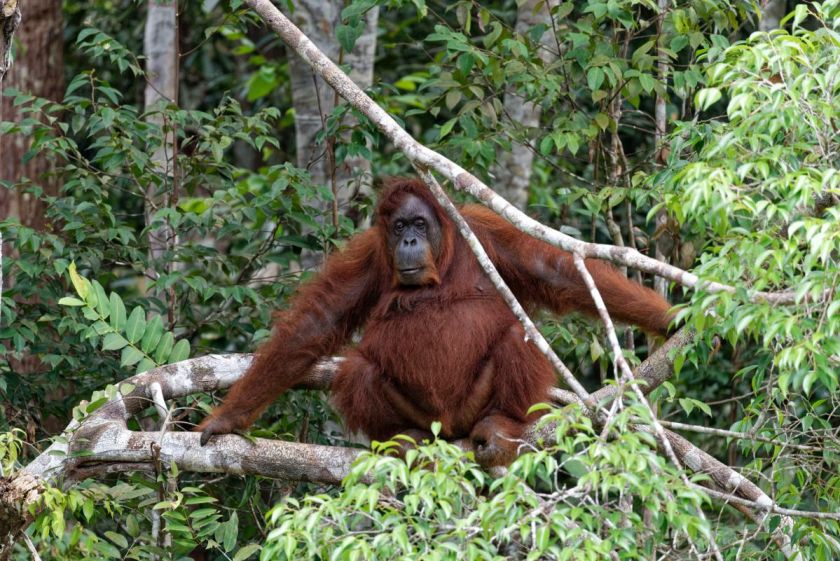
The matriarch was in a tree near the parking lot and ironically closer and easier to observe than if she’d come to the feeding platform. It was Seduku. She’s nicknamed the ‘Grand Old Lady’, born in 1971.

The Grand Old Lady

Seduku could be aggressive towards tourists, our guide said. But the morning we ‘met’ her she was mellow (and almost seemed to be showing off). All I can say is that she had a conscious dignity. Kudos to the great work being done on behalf of orangutans at the Semenggoh Rehab Centre!

NOTES: [1] Kasakela chimpanzee community [2] Semenggoh Wildlife Centre [3] Not getting to see the endangered animals at a feeding station means that they’ve rehabilitated into their natural habitat. Not seeing them is a good thing. This is an ironic moment for any tourist. To learn more about the rehab center, go to their website at https://semenggoh.my/ ©2024 Jadi Campbell. Previously published as Borneo’s Wild Orangutans. All photos © Uwe Hartmann. To see more of Uwe’s animal photos and pics from our trips go to viewpics.de.

My books are Broken In: A Novel in Stories, Tsunami Cowboys,  Grounded and The Trail Back Out.

Tsunami Cowboys was longlisted for the 2019 ScreenCraft Cinematic Book Award. Broken In: A Novel in Stories was semifinalist for the international 2020 Hawk Mountain Short Story Collection Award from Hidden River Arts and Finalist for Greece’s 2021 Eyelands Book of the Year Award (Short Stories). The Trail Back Out was the 2023 San Francisco Book Festival Winner for General Fiction, American Book Fest 2020 Best Book Award Finalist: Fiction Anthologies, Runner-Up for the 2021 Top Shelf Award, 2021 IAN Book of the Year Award Short Story Collection Finalist, and awarded a 2021 Wishing Shelf Red Ribbon. The title story The Trail Back Out was longlisted for the 2021 ScreenCraft Cinematic Short Story Award.

Click here for my author page to learn more about me and purchase my books.